
India’s Electricity Sector Growth (1947–2025): From Power Scarcity to a Renewable Future
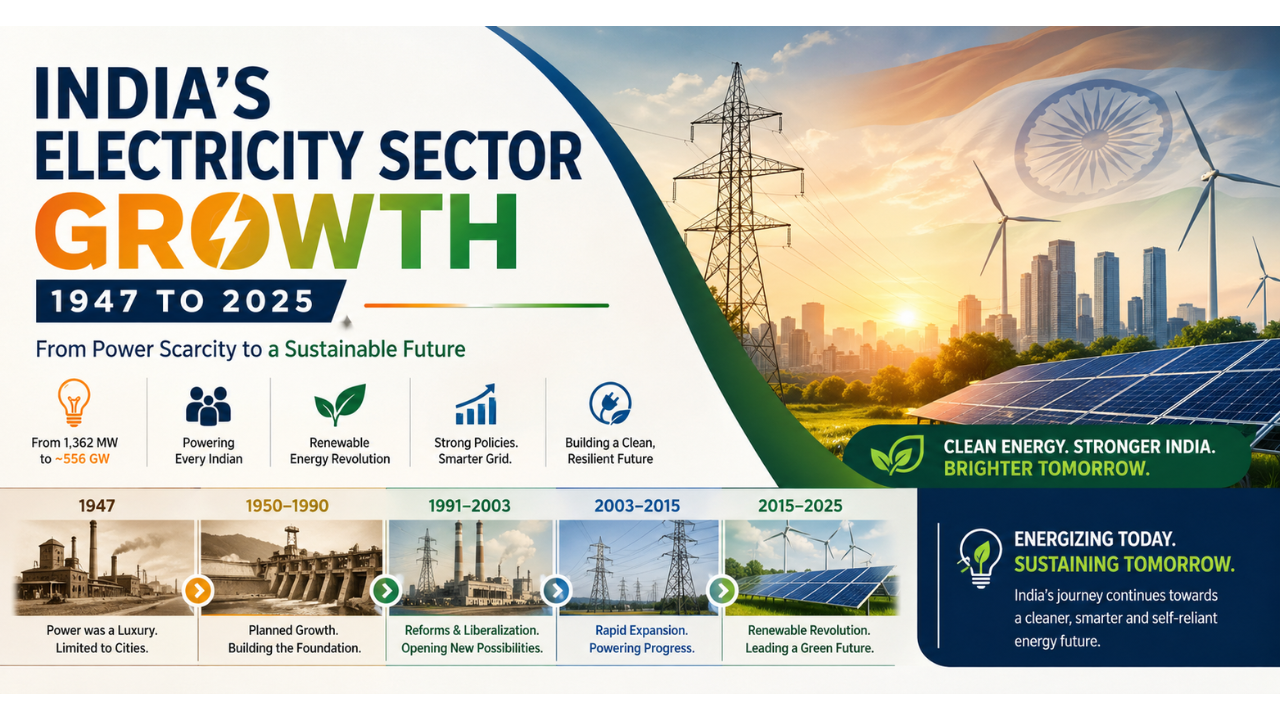
India’s Electricity Sector Growth (1947–2025): From Power Scarcity to a Renewable Future
Introduction
India’s electricity sector growth from 1947 to 2025 tells a remarkable story of transformation—from acute power shortages to becoming one of the world’s largest energy markets. At independence, electricity was scarce, unreliable, and largely limited to urban pockets. Today, India powers homes, industries, digital infrastructure, and a rapidly growing economy.
Electricity has been central to India’s economic development—fueling industrialization, improving quality of life, and enabling technological advancement. From the early days of coal-dominated generation to today’s clean energy transition, the sector has evolved through strong policy support, infrastructure investment, and innovation.
What makes this journey even more compelling is the shift now underway—from conventional energy dominance to sustainability. India is not just expanding electricity access; it is redefining how power is generated and consumed, with renewable energy leading the way toward a cleaner and more resilient future.
Electricity Sector in 1947: The Starting Point
At the time of independence, India’s electricity infrastructure was minimal and fragmented.
- Installed capacity: ~1,362 MW
- Supply was largely urban-centric
- Rural areas had little to no access
- Electricity was considered a luxury, not a necessity
The sector was primarily driven by private utilities and small regional systems, with limited coordination or long-term planning.
Planned Development Phase (1950–1990)
India adopted a structured approach to power development through centralized planning.
Key Developments
- Formation of State Electricity Boards (SEBs) to manage generation and distribution
- Electricity became a core focus in Five-Year Plans
- Establishment of major public sector entities:
- NTPC (thermal power)
- NHPC (hydropower)
- NPCIL (nuclear power)
Growth Trends
- Expansion of coal-based thermal power plants
- Development of large hydroelectric projects
- Increased rural electrification efforts
This phase laid the foundation for India’s large-scale power infrastructure.
Liberalization & Reforms (1991–2003)
Economic reforms in the 1990s opened the electricity sector to private participation.
Major Milestones
- Entry of independent power producers (IPPs)
- Policy changes encouraging private investment
- Electricity Act 2003—a landmark reform
Impact of Electricity Act 2003
- Unbundling of:
- Generation
- Transmission
- Distribution
- Introduction of open access
- Promotion of competition and efficiency
This period marked a structural shift toward a market-driven power sector.
Rapid Expansion Era (2003–2015)
Post-reform, India witnessed significant growth in electricity capacity and access.
Key Highlights
- Rapid increase in installed capacity
- Rising demand from:
- Industries
- Urban households
- Strengthening of the national grid
Infrastructure Growth
- Development of inter-state transmission networks
- Improved grid connectivity across regions
- Reduction in regional power imbalances
Electricity became more accessible and reliable during this period.
Renewable Energy Revolution (2015–2025)
The last decade has defined India’s shift toward clean and sustainable energy.
Key Trends
- Massive expansion of solar and wind energy
- Renewable capacity crossing 250 GW by 2025
- Solar energy emerging as a dominant growth driver
Transformational Changes
- Declining solar tariffs making it cost-competitive
- Reduced reliance on fossil fuels
- Strong policy push for renewable adoption
India is now among the global leaders in renewable energy deployment.
Key Growth Statistics
- Installed capacity: 1,362 MW → ~556 GW (2025)
- Per capita consumption: 16 units → ~1400 units
- Electrification: ~3,000 villages → nearly 100% coverage
- Expansion of transmission network across the country
- Significant reduction in power shortages
These numbers highlight the scale and speed of India’s electricity sector growth.
Role of Solar Energy in India’s Growth
Solar energy has become the fastest-growing segment in India’s power sector.
Why Solar is Leading
- Rapid decline in installation costs
- Scalable for both utility-scale and rooftop systems
- Strong government support
Key Drivers
- Rooftop solar adoption in residential and commercial sectors
- Subsidy schemes like PM Suryaghar
- Net metering policies
Solar energy is not just an alternative—it is becoming a mainstream power solution for millions of Indians.
Challenges in the Electricity Sector
- Transmission & distribution losses (~17%)
- Financial stress of DISCOMs
- Continued coal dependency
- Integration challenges for renewable energy into the grid
Addressing these issues is critical for sustainable growth.
Future Outlook (2025–2030 and Beyond)
India’s electricity sector is entering a new phase of innovation and sustainability.
Key Opportunities
- Target of 500 GW non-fossil fuel capacity
- Growth of electric vehicles (EVs)
- Deployment of smart grids
- Expansion of energy storage technologies
- Increased adoption of rooftop solar systems
The future is decentralized, digital, and green.
About Elpower Solar
Elpower Solar is a leading solar energy company based in Odisha, dedicated to accelerating India’s clean energy transition.
What We Do
- Rooftop solar installation for:
- Residential
- Commercial
- Industrial clients
- End-to-end solutions:
- Consultation
- System design
- Installation
- Maintenance
Our Focus
- Maximizing cost savings for customers
- Promoting sustainability
- Assisting with government subsidies and approvals
Our Mission
To make clean, affordable solar energy accessible across India and empower individuals and businesses to take control of their energy future.
Call to Action
Looking to reduce your electricity bills and embrace clean energy?
Contact Elpower Solar today for expert solar installation services in Odisha.